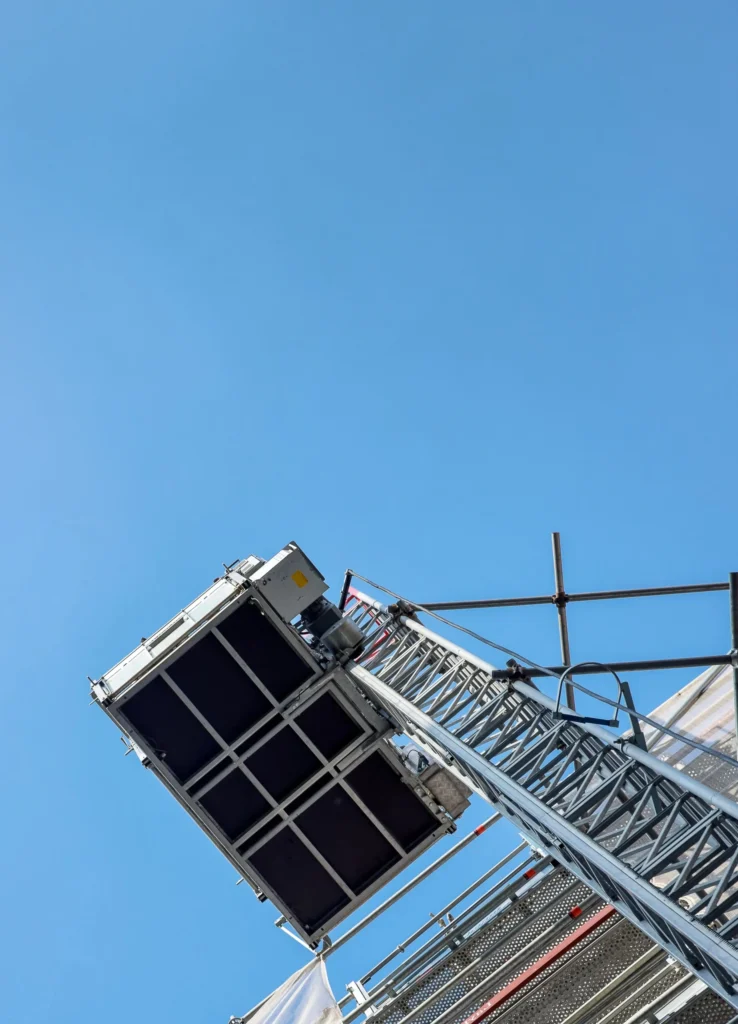

When it comes to transport platforms on construction sites, the first thing that usually comes to mind is the vertical movement of people, equipment and materials.
This is certainly their primary function: reducing movement along scaffolding and temporary structures, speeding up operations and making work organisation more efficient. However, a transport platform can also play an important role in a situation that, fortunately, is not something we think about every day: managing an unexpected event involving a worker at height. This is where the combination of transport platforms and construction site safety comes into play.
Safety is built before an emergency occurs
On a construction site, every detail is planned: routes, materials, schedules and operations. The same should apply to the management of a potential emergency.
Imagine a construction site extending over several levels. Workers are constantly moving between ground level and the various working heights, while materials and equipment need to reach operational areas quickly. During a normal working day, a worker may suddenly feel unwell or need assistance getting back down to ground level.
In such a situation, navigating flights of stairs, narrow passages or complex routes along scaffolding can make movement considerably more difficult.
This highlights a fundamental principle: safety must be planned before an emergency occurs. A properly designed vertical transport system, integrated into the organisation of the construction site, can provide practical support by facilitating the return to ground level in accordance with established safety procedures.
Why can it make a difference?
In addition to improving everyday productivity, a transport platform can help to:
- reduce movement along scaffolding stairs;
- speed up access to ground level;
- facilitate assistance to a worker;
- make emergency management more orderly and efficient.
These aspects are often overlooked when selecting equipment, but they can have a tangible impact on the organisation of a construction site.
An efficient construction site is also a well-organised one
When designing a vertical transport system, load capacity, height and speed should not be the only factors considered. It is equally important to assess how the system can help make the construction site safer and better organised.
A properly sized transport platform can improve everyday operations by allowing workers to reach different working heights without relying exclusively on scaffolding stairs. At the same time, it enables materials and equipment to be moved while reducing long or difficult manual handling routes.
For a transport platform to provide effective support, simply choosing a model and installing it on site is not enough.
Several factors need to be assessed:
- the configuration of the building or structure;
- the total heights involved;
- the number of landing points;
- the number of workers on site;
- the loads and materials to be transported;
- the different phases of work;
- the planned operating and emergency procedures;
- the platform’s supporting surface.
The positioning of the platform can also make a significant difference. A system installed in a location that is difficult to access or far from the main operational areas may not provide all the expected benefits.
For this reason, the design process should begin with a practical analysis of the construction site rather than focusing solely on the technical characteristics of the equipment.
Planning with unexpected events in mind
A well-organised construction site is not one where unexpected events never happen. It is one that has the tools and procedures required to deal with them in the most orderly way possible. Planning routes, access points and vertical transport systems in advance helps avoid having to improvise when they are needed most.
A transport platform therefore becomes more than just a machine designed to connect different levels. It becomes part of the overall organisation of the project, contributing to operational continuity and helping manage exceptional situations.
Sky Lift’s approach
When we design a vertical transport solution, we do not simply consider how much material needs to be moved or what height needs to be reached. We analyse the operating environment, access points, workflows and the needs of the people who will use the system every day. Our goal is to identify a configuration that can make the construction site more efficient, better organised and better prepared to deal with unexpected situations.
Because safety does not depend on a single element. It comes from a combination of carefully planned choices, procedures and details.
And on a construction site, every detail can make a difference.